
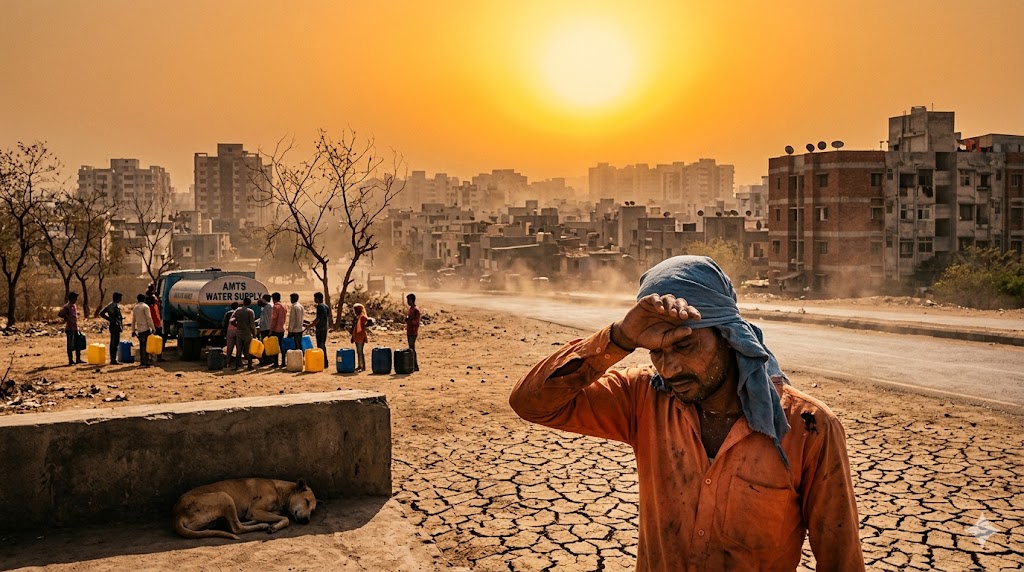
A Heatwave Beyond Weather: India at the Center of a Climate Signal
The scale of the current crisis reflected in India heatwave hottest cities is not simply a meteorological anomaly but a structural indicator of how climate volatility is beginning to reshape economic and geopolitical realities. Reports that ninety eight of the world’s hottest cities are located in India during this period highlight a concentration of extreme conditions that is unprecedented in both scale and intensity. This is not an isolated seasonal fluctuation but part of a broader pattern where rising global temperatures are interacting with urban density, infrastructure limitations, and economic activity to produce compounded stress. The India heatwave hottest cities phenomenon therefore becomes a case study in how climate events are transitioning from environmental concerns to systemic risks that affect multiple layers of society.
The significance of this event lies in its ability to disrupt not just daily life but also the underlying mechanisms of economic productivity and social stability. Extreme heat affects labor efficiency, increases health risks, and places immense pressure on public infrastructure, particularly in urban areas where heat retention is higher. The concentration of such conditions in a single country amplifies the global implications, as India is deeply integrated into international supply chains and economic networks. The India heatwave hottest cities situation thus moves beyond national boundaries, signaling to global observers that climate risk is becoming a central variable in economic planning and geopolitical strategy.
Why This Heatwave Is Happening and What It Reveals
The underlying causes of India heatwave hottest cities can be traced to a combination of global and local factors, where climate change interacts with regional dynamics to produce extreme outcomes. Rising global temperatures have increased the baseline from which seasonal heat builds, making extreme events more likely and more intense. At the same time, urbanization has created environments where heat is absorbed and retained by concrete structures, reducing the ability of cities to cool naturally. This urban heat effect amplifies the impact of rising temperatures, particularly in densely populated areas where ventilation and green cover are limited.
In addition to these structural factors, atmospheric conditions such as delayed monsoon patterns and reduced cloud cover have contributed to prolonged heat exposure. These conditions limit the natural mechanisms that typically provide relief, extending the duration of extreme temperatures. The India heatwave hottest cities phenomenon therefore reflects a convergence of factors rather than a single cause, highlighting the complexity of climate systems and their interaction with human activity. This complexity makes prediction and mitigation more challenging, requiring a multidimensional approach that integrates environmental, urban, and economic considerations.
Economic Shockwaves: From Energy Demand to Inflation
The economic impact of India heatwave hottest cities is immediate and multifaceted, affecting sectors ranging from energy to agriculture and manufacturing. One of the most visible effects is the surge in electricity demand as households and businesses increase their use of cooling systems. This creates pressure on power grids, which must operate at higher capacity for extended periods, increasing the risk of outages and raising operational costs. These costs are often passed on to consumers, contributing to inflationary pressures that affect the broader economy.
Beyond energy, the heatwave has significant implications for agricultural productivity, as high temperatures can reduce crop yields and affect food supply. This can lead to higher food prices, further contributing to inflation and impacting household budgets. The interplay between energy demand and food supply creates a dual pressure that can strain economic stability, particularly in a country where a large portion of the population is sensitive to price changes. The India heatwave hottest cities scenario therefore becomes a driver of economic adjustment, where policy responses must address both immediate impacts and long term resilience.
Global Implications: Climate Risk as a Market Variable
The concentration of extreme heat in India has implications that extend into global markets, particularly as investors and policymakers increasingly factor climate risk into decision making. India’s role in global supply chains means that disruptions in productivity can have ripple effects across industries, from manufacturing to technology services. Reduced labor efficiency due to extreme heat can affect output, leading to delays and increased costs that propagate through international networks. This introduces a new dimension of risk that must be accounted for in global trade and investment strategies.
Financial markets are also sensitive to such developments, as they influence expectations around growth, inflation, and policy responses. Increased energy demand can lead to higher fuel consumption, affecting oil markets and contributing to price volatility. At the same time, inflationary pressures may prompt central banks to adjust monetary policy, influencing currency values and capital flows. The India heatwave hottest cities event thus becomes part of a broader narrative where climate events are integrated into economic forecasting, altering how markets respond to environmental developments.
India’s Strategic Challenge: Balancing Growth and Resilience
For India, the current heatwave represents a strategic challenge that requires balancing economic growth with the need for climate resilience. The country’s rapid development has increased energy demand and urban expansion, both of which contribute to vulnerability during extreme weather events. Addressing this challenge requires investment in infrastructure that can withstand higher temperatures, including energy systems that are both efficient and sustainable. Renewable energy sources, improved urban planning, and enhanced cooling technologies are part of the solution, but their implementation requires coordinated policy and significant investment.
At the same time, the India heatwave hottest cities situation highlights the importance of social resilience, where public health systems and community support structures must be strengthened to manage the impact of extreme conditions. The ability to respond effectively to such events will influence not only economic outcomes but also social stability, as prolonged stress can lead to broader challenges. This underscores the need for a comprehensive approach that integrates environmental, economic, and social considerations into national strategy.
Future Scenarios: Climate as a Defining Economic Force
Looking ahead, the implications of India heatwave hottest cities suggest that climate events will play an increasingly central role in shaping economic and geopolitical landscapes. One potential scenario is that continued warming leads to more frequent and intense heatwaves, requiring sustained adaptation efforts and influencing long term growth trajectories. In this scenario, countries that invest in resilience and innovation may gain a competitive advantage, while those that struggle to adapt may face economic constraints.
Another scenario involves accelerated global cooperation on climate issues, driven by the recognition that extreme events have shared consequences. This could lead to increased investment in sustainable technologies and policy frameworks that aim to mitigate risk and enhance resilience. However, the transition to such a framework is complex, involving trade offs between short term costs and long term benefits. The India heatwave hottest cities event serves as a reminder that these decisions cannot be delayed indefinitely, as the cost of inaction continues to rise.
Conclusion
The current heatwave in India is more than a weather event. It is a signal of how climate change is intersecting with economic systems to create new forms of risk and opportunity. The concentration of the world’s hottest cities within a single country underscores the scale of the challenge, while also highlighting the interconnected nature of global systems. As economies adapt to these conditions, the ability to integrate climate considerations into policy and strategy will become increasingly important. The India heatwave hottest cities phenomenon thus represents both a warning and a call to action, emphasizing the need for a coordinated response that addresses the complexities of a changing environment.
